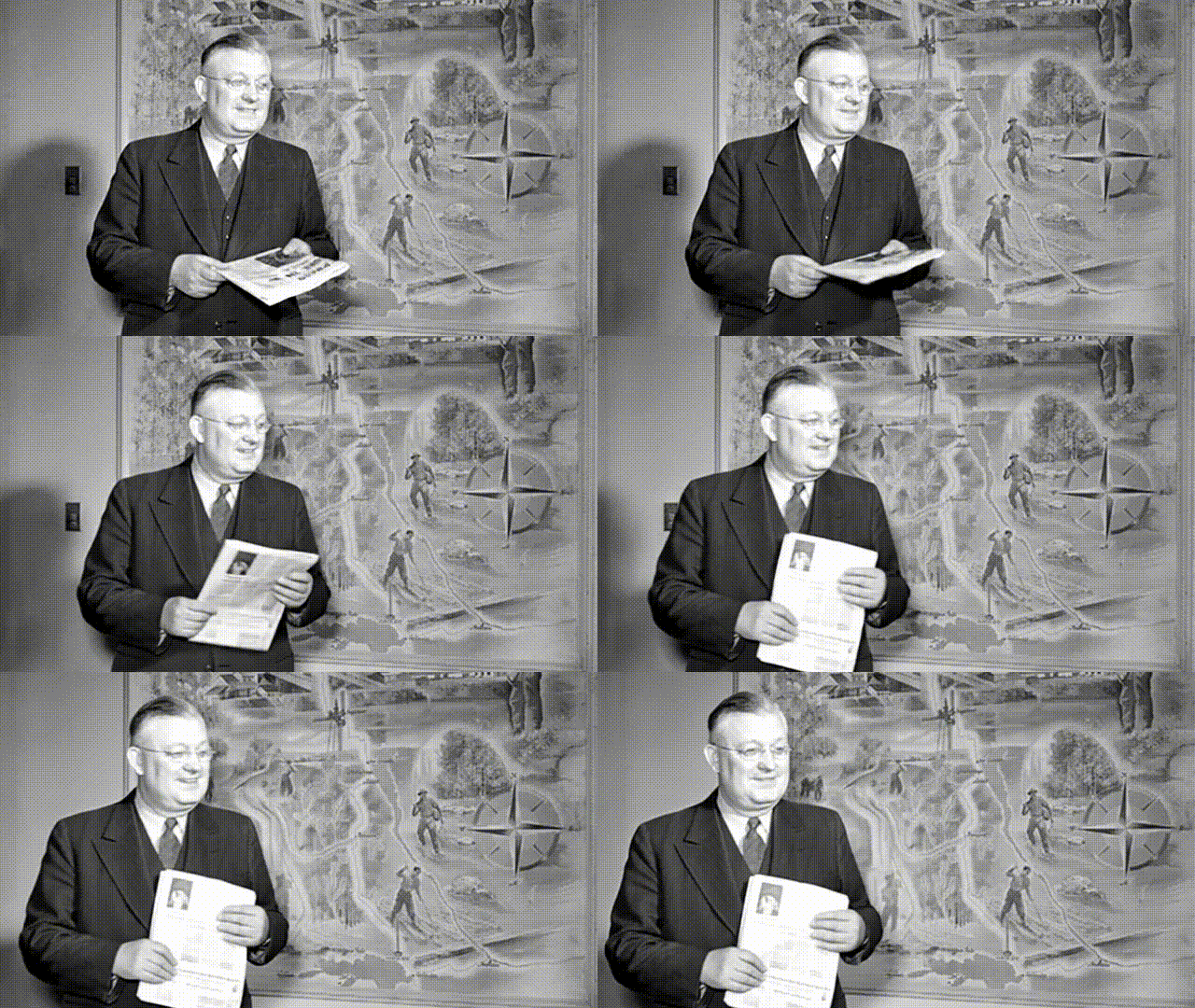
Roy Herbert Thomson, 1st Baron Thomson of Fleet
Building an empire one small brick at a time
“
If you want to live and you want to prosper, you’ve got to be ambitious.
Success stories often skip the messy parts, but for Roy Thomson (1894-1976), the failures were the whole point. Born in Toronto to a modest family, his early career was a string of humbling ventures. He tried farming on the prairies and lost his shirt. He went into the auto parts business, only to be crushed by a cash flow crisis when customers didn’t pay on time. By the time he was in his mid-thirties, Thomson had a list of what didn’t work, but no great success to his name.
His big break came not from a grand vision, but from a simple problem. In 1930, he was in Northern Ontario, struggling to sell radios in a region with no reliable broadcast signal. His solution was practical: if he wanted to sell the radios, he’d have to create the market himself. At 36, an age when many entrepreneurs are already established, Thomson bought a broadcast license for a single dollar and launched his first radio station, CFCH North Bay, in 1931.
Thomson had no passion for radio broadcasting; he was obsessed with building a profitable business. That first station was the start of a formula he would perfect over the next two decades. He expanded his radio network across Northern Ontario before pivoting to print, acquiring the Timmins Daily Press in 1934 with a down payment of just $200.
Thomson’s strategy showed the spirit of a true builder. He targeted small, isolated Canadian towns where he could buy the only newspaper, securing a local advertising monopoly. He then imposed strict, centralized financial controls while leaving the local editors alone. It wasn’t glamorous, but it was a licence to print money, long before he ever used that phrase for his later television venture.
This Canadian-forged model was ruthlessly efficient. Thomson used the profits from one newspaper to buy another, and then another. Canada, with its vast geography and scattered towns, was the perfect laboratory for his empire. It provided the overlooked markets that allowed him to build a coast-to-coast chain of 19 newspapers, becoming president of the Canadian Daily Newspaper Publishers Association by the early 1950s.
Having built a formidable Canadian enterprise from the ground up, Thomson was ready for his next chapter. In 1953, he moved to the United Kingdom, confident that the lessons learned in the towns of Northern Ontario could build an empire on a global scale. Settling in Edinburgh, he acquired The Scotsman newspaper, got into the television business, and gradually built a multimedia empire that included over 200 newspapers in Canada, the U.S., and the UK. The jewel of these holdings was The Times of London, which he bought from the Astor family in 1966.
For his efforts, in 1964 he was made Baron Thomson of Fleet, a peerage that cost him his Canadian citizenship. Nevertheless, his connections to his country of birth remained strong; Roy Thomson Hall in Toronto is named in his honour, thanks to the $5.4 million his family donated towards its construction.
Today, the company that began with his acquisition of the Timmins Daily Press in 1934 is the global media concern Thomson Reuters. This enduring empire has established the Thomsons as the wealthiest family in Canada. Its chairman is David Thomson, his grandson, who in the UK uses his inherited title, 3rd Baron Thomson of Fleet.
Roy Thomson’s story is a powerful reminder that the foundation for massive success can be laid brick by brick, step by step, and that it’s never too late to start building.