“
Helping shape the world's understanding of 'time' was one of my greatest achievements, and as a result of using my own time well, other people could use their time well too
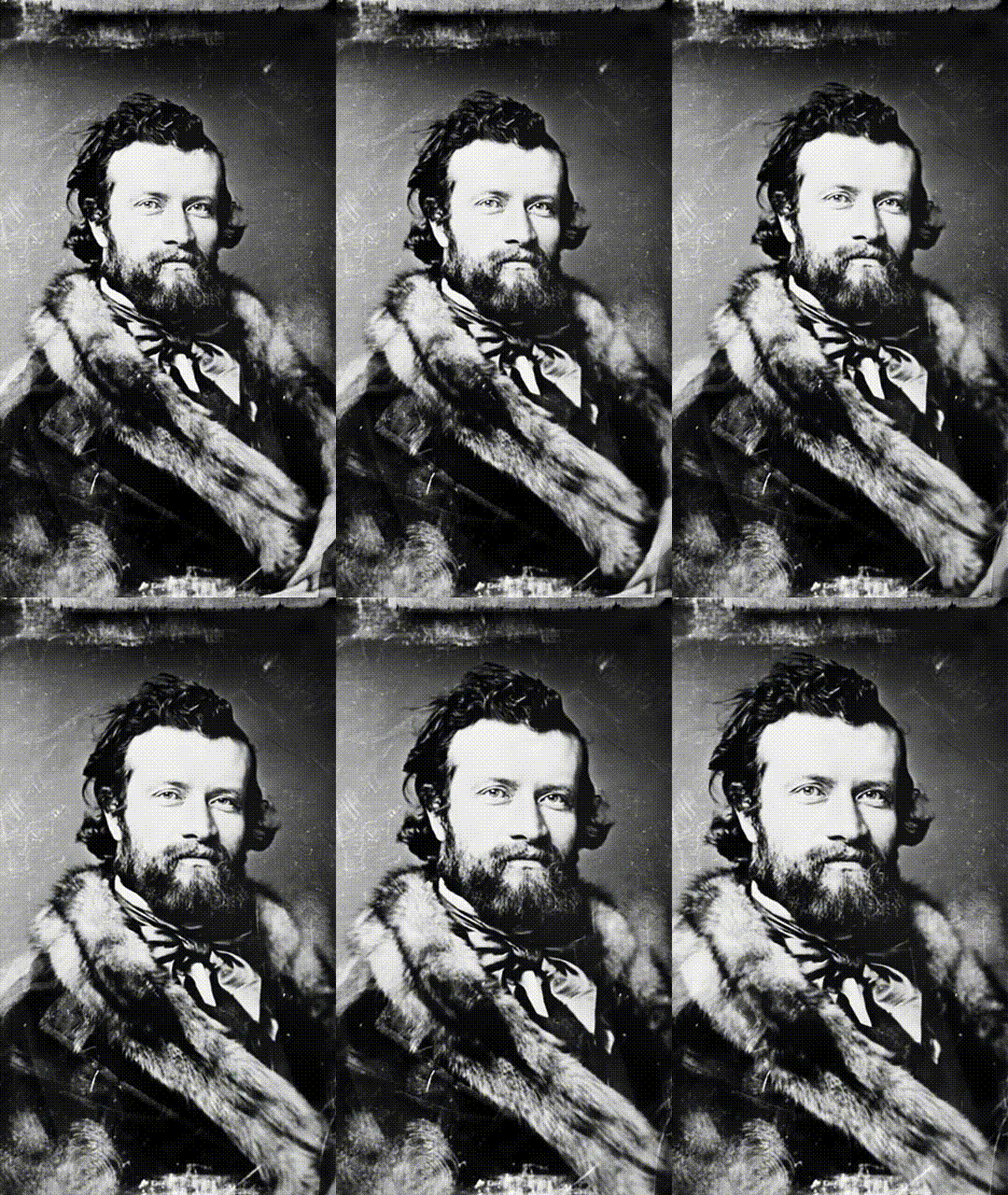
Any one of Sir Sandford Fleming’s accomplishments might have been enough to secure his place in the history of Canada: He designed our first postage stamp, founded the Royal Canadian Institute, surveyed huge tracts of the country, was the chief engineer of the Canadian Pacific Railway. But what makes him one of the most important Canadians who ever lived, is what he gave the world: the single, synchronized heartbeat known as Standard Time.
Born in 1827 in Kirkcaldy, Scotland, Fleming arrived in Canada as a teenager armed with little more than a knack for doodling and a restless imagination. He apprenticed as a surveyor and quickly became indispensable to the engineers and builders shaping a young nation’s destiny. By the 1850s, his work mapping rail lines and designing bridges had earned him widespread recognition as one of the colony’s leading civil engineers. But his greatest contributions were still to come.
Fleming’s fingerprints are on nearly every great infrastructure project of 19th-century Canada. He was chief engineer of the Intercolonial Railway, connecting the Maritimes to Quebec, and later the Canadian Pacific Railway—the spine that would bind the country from coast to coast. These weren’t just feats of engineering, they were exercises in imagination and required a belief that this land could exist as more than a patchwork of disconnected colonies. Every rail spike drove home the idea of a single nation.
Yet the development of the railway system revealed a profound problem as it grew. Every town kept its own local time, set by the position of the sun relative to its location. The result was pure chaos: a train leaving Montreal at “noon” might arrive in Toronto before it had technically departed. After missing a train in Ireland while travelling, Fleming realized that a land as vast as Canada couldn’t function in the modern world without a shared rhythm. And indeed, that the world beyond would never be connected as one without such a system.
In 1879, he proposed dividing the Earth into 24 time zones, each representing one hour of the planet’s rotation. His idea was first presented in Toronto and later championed internationally. It was received as radical, elegant, and world-changing by supporters and critics alike. By the 1884 International Meridian Conference in Washington, D.C., his system was accepted almost entirely, giving rise to Coordinated Universal Time and the time zones we still use today.
The economic impact of Fleming’s vision was enormous. Standardized time allowed railways, shipping companies, and eventually telegraph and telephone networks to operate efficiently and safely across long distances. It was the invisible governance structure upon which global trade, industry, and communication could grow. In an age defined by industrial acceleration and change, Fleming gave the world the means to keep pace.
Canada was both his canvas and his catalyst. Its immense geography demanded precision and coordination and its spirit of possibility gave him room to dream. Fleming later became Chancellor of Queen’s University and helped establish the Royal Society of Canada, continuing his deeply-held mission to advance knowledge and progress.
For his efforts, he was knighted by Queen Victoria in 1897, for his service to Canada and to the Empire. Sir Sandford Fleming didn’t just build railways—he built our notion of time itself. His legacy endures every time a train departs on schedule, a plane crosses an ocean, or a Canadian glances at their wristwatch.